
💸 Collections
At VirtualHOA.com, our collections process is designed to protect the financial health of your association while maintaining a fair, consistent, and respectful approach toward homeowners.
This article outlines how we support the Board of Directors in managing delinquencies—from early-stage reminders through third-party collections—while remaining aligned with your governing documents.
👉 Board Collections Presentation: Link
👉 Board Collections Brochure: Link
👉 Homeowner-facing explanation of this process: Link
Overview of the Collections Approach
Our process follows a structured escalation model:
Billing & Grace Period
Internal Delinquency Notices
Referral to Third-Party Collections
Board-Directed Escalation (if needed)
This approach balances timely recovery, homeowner communication, and compliance with legal and governing requirements.
Step 1: Billing, Due Dates, and Late Fees
We administer a consistent billing cycle to ensure clarity and enforceability:
Assessments are due on the 1st of each month
A 15-day grace period is provided
Late fees are applied on the 16th in accordance with your governing documents
Monthly statements are issued around the 16th, reflecting balances and any late fees
This standardized cadence helps establish clear expectations and supports defensible collections practices.
Step 2: Early-Stage Delinquency Management
When an owner becomes delinquent:
We issue a collections warning notice after the grace period lapses
Communication is timely, professional, and documented
The goal is to resolve delinquencies early without escalation
This stage is critical in reducing downstream collections activity and preserving owner relationships.
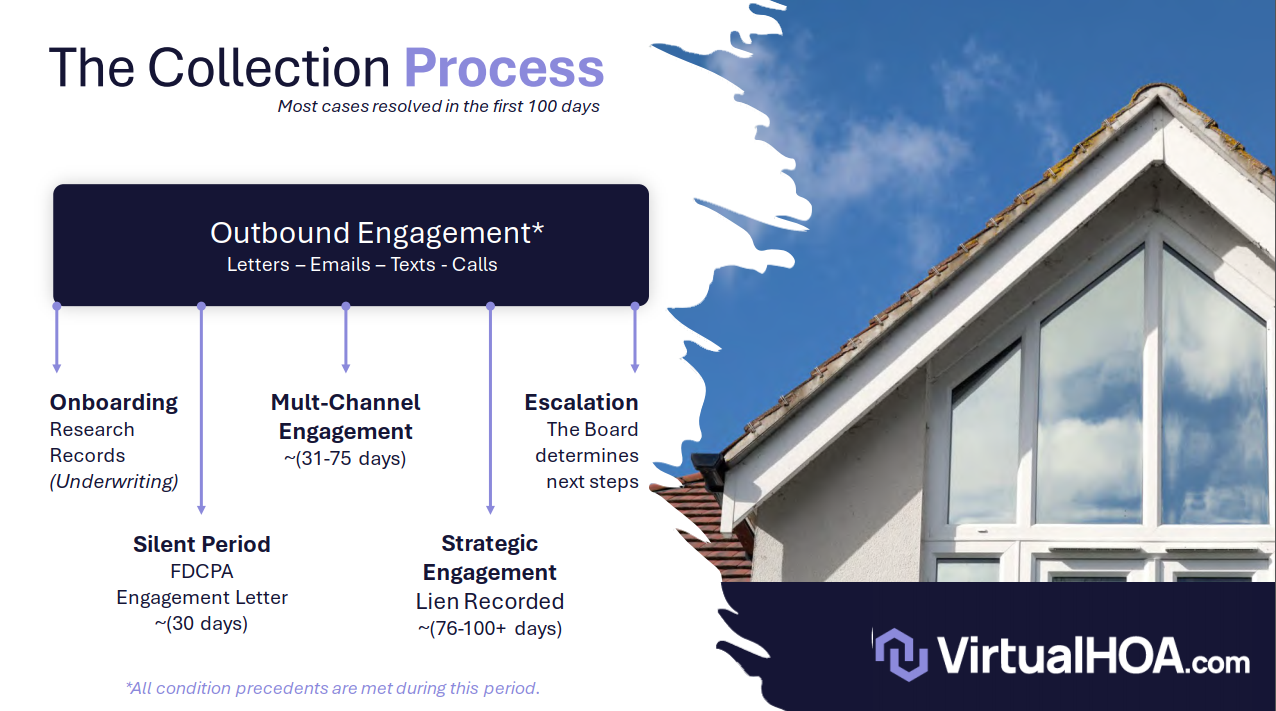
Step 3: Referral to Third-Party Collections (~45 Days Past Due)
If the account remains unpaid into the following billing cycle (approximately 45 days past due), we transition the account to a third-party collections partner.
What Happens at Referral
The account is placed with a specialized HOA collections platform
The homeowner is required to work directly with the collections firm
Owner portal access is restricted until the account is brought current
Certain privileges (ARC submissions, amenities) may also be limited
Step 4: Collections Strategy & Oversight
Our collections partner follows a compliant, board-aligned process, including:
Multi-channel homeowner outreach (mail, email, phone, text)
Underwriting and account review (ownership, mortgage status, etc.)
Transparent tracking of all communications and actions
Escalation pathways that are subject to Board direction
All collection activities adhere to:
Your association’s governing documents
Applicable federal and state regulations
Pre-established Board policies
Financial Considerations
A key advantage of our approach is that:
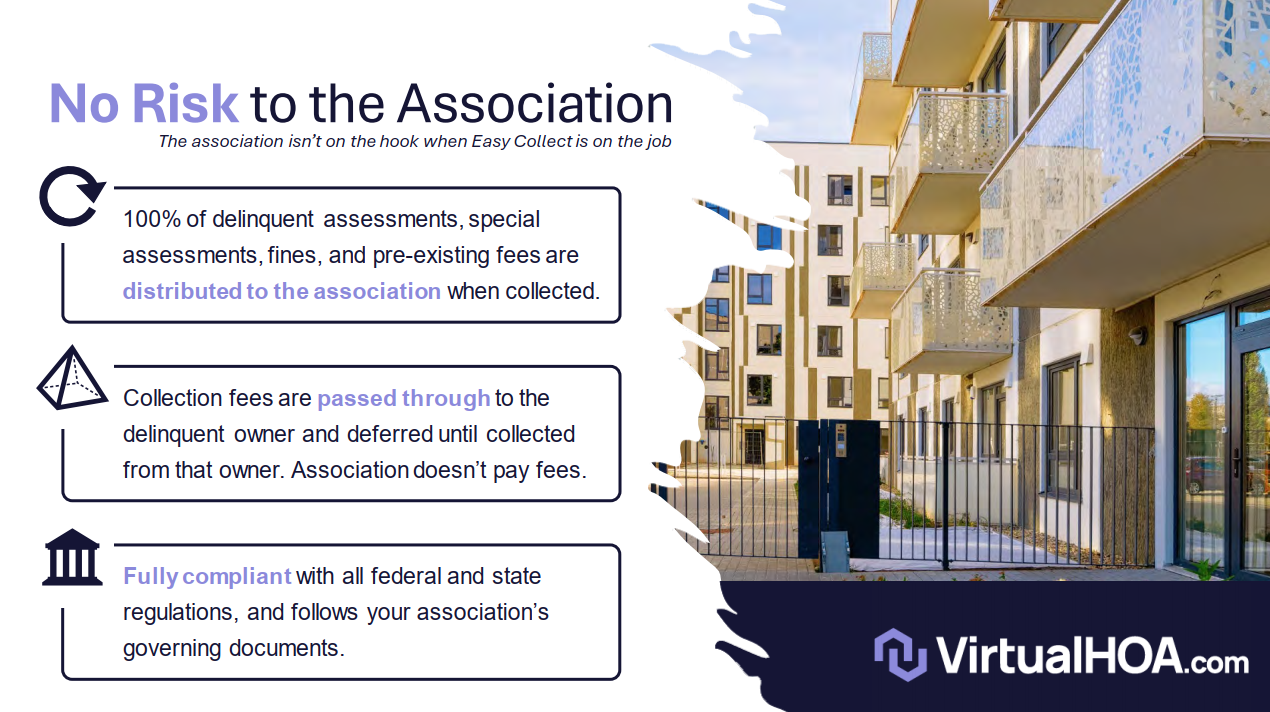
Collection costs are generally passed through to the delinquent owner
The association receives 100% of recovered assessments and charges
Legal escalation is used only when necessary and typically as a last resort
This reduces financial risk to the association while maintaining strong recovery outcomes.
Benefits to the Board
By utilizing VirtualHOA’s collections process, your Board benefits from:
✅ Consistency & Compliance
A clearly defined process aligned with governing documents and legal requirements
✅ Reduced Administrative Burden
We manage billing, notices, coordination, and vendor oversight
✅ Transparency
Detailed reporting and visibility into collection activity
✅ Higher Recovery Efficiency
Structured outreach often resolves accounts before legal escalation is required
✅ Community-Focused Approach
Delinquencies are handled professionally to maintain neighborhood stability
Board Control & Decision-Making
While we manage the day-to-day process, the Board retains control over:
Escalation thresholds and policies
Legal action approval (if applicable)
Collection strategy preferences
Our role is to execute consistently and advise, while ensuring the Board remains in the driver’s seat.
Best Practices for Boards
To ensure an effective collections program, we recommend:
Maintaining clear and enforceable collection policies
Applying rules consistently across all owners
Acting promptly on delinquencies (aging increases risk)
Reviewing monthly delinquency reports
Questions or Updates to Your Policy?
If your Board would like to review or refine your collections policy, please contact us. We can help align your policy with best practices and your governing documents.